
 Posted by
Every year, lakhs of people open a railway job page, see twelve exam names and close it again, unsure where they belong. The confusion is understandable. Indian Railways hires through several bodies, under different notification numbers, for roles that range from track maintenance to engineering supervision. This guide does one job: it helps you work out which exam fits you, what the process feels like, and what to check before you invest months of preparation.
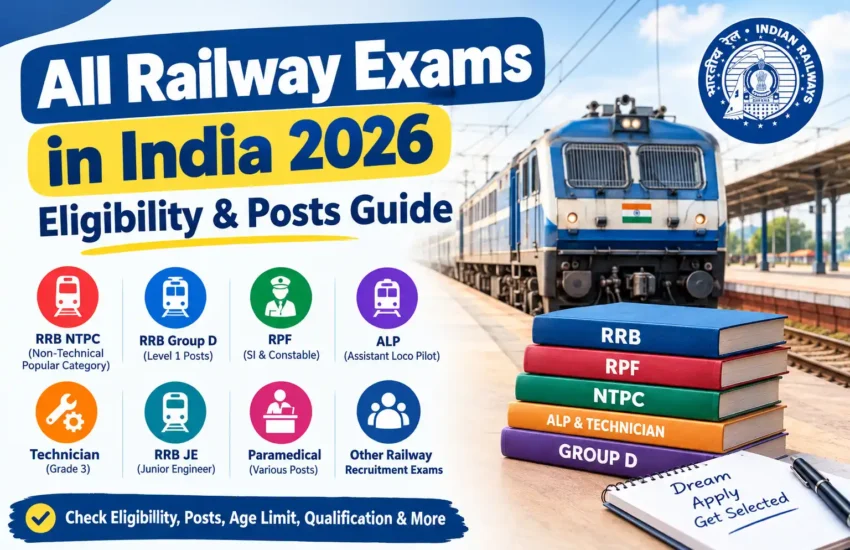
The major railway exams at a glance
| Exam | Typical minimum qualification | Example posts | Usual stages |
|---|---|---|---|
| Group D (Level 1) | 10th, ITI or NAC | Track Maintainer, Pointsman, Assistants | CBT, PET, documents, medical |
| Assistant Loco Pilot (ALP) | 10th with ITI or technical diploma | Assistant Loco Pilot | Two CBT stages, aptitude test, documents, medical |
| Technician | 10th with ITI (Grade III); higher for Grade I | Technician Grade I and III | CBT stages, documents, medical |
| NTPC | 12th (undergraduate) or any degree (graduate) | Clerks, Goods Guard, Station Master, Traffic Assistant | Two CBTs, typing or aptitude test where applicable |
| JE | Engineering diploma or degree | Junior Engineer, DMS, Chemical and Metallurgical Assistant | Two CBTs, documents, medical |
| SSE | Engineering degree | Senior Section Engineer | CBT based, notification specific |
| Paramedical | Varies by post, with registration for clinical roles | Staff Nurse, Pharmacist, Radiographer | CBT, documents, medical |
| Ministerial and Isolated | Varies widely | Stenographer, Translator, Teacher | CBT, plus skill test for some |
| RPF | 10th (Constable), degree (Sub-Inspector) | Constable, Sub-Inspector | CBT, physical tests, documents |
| UPSC services | Degree, engineering degree or MBBS by service | IRTS, IRSE, Railway Medical Service | UPSC prelims, mains, interview |
Who actually conducts railway exams?
Most candidates meet three names: the Railway Recruitment Boards (RRBs), the Railway Recruitment Cells (RRCs) and UPSC. RRBs run the large centralised exams. RRCs are zonal bodies that handle certain recruitments such as apprenticeships. UPSC picks Group A officers. For policing roles, the conducting body has changed over time, so check the latest RPF notification before assuming. The practical rule: the CEN (Centralised Employment Notification) is the only document that settles who conducts what, and the central application portal at rrbapply.gov.in is where candidates usually apply.
If you have passed 10th
Group D (Level 1)
The most accessible entry point and usually the largest by number of posts. The current cycle, CEN 09/2025, advertised 22,195 Level 1 posts, accepted 10th pass, ITI or NAC holders, and set the age range at 18 to 33 as on 1 January 2026. Its computer-based test was held in August 2026, and the result was still awaited at the time of writing. Selection includes a physical efficiency test, so fitness matters as much as marks. For full details, see our dedicated RRB Group D guide.
ALP and Technician
These suit people with an ITI or a relevant technical diploma who prefer machines to desk work. ALP is a train-operations role and involves an aptitude test and strict medical standards, including vision. Technician is maintenance work across electrical, mechanical and signalling. Both are usually advertised together, and the first test stage is commonly shared.
RPF Constable and apprenticeships
RPF Constable asks for 10th pass plus physical standards. Railway apprenticeships are training positions, not regular jobs, selected mainly on marks, but they build trade experience that supports later applications.
If you have passed 12th, or hold a degree
NTPC is the largest non-technical route. Undergraduate posts (like clerks and ticket clerks) need 12th pass; graduate posts (like goods guard, station master and traffic assistant) need any degree. Expect two computer-based stages that test general awareness, mathematics and reasoning, with a typing or aptitude test for specific posts. Station Master hopefuls should read the notification closely for the aptitude test requirement. Graduates who want the highest-level railway posts can also take UPSC Civil Services.
If you have an engineering diploma or degree
JE is the standard door for diploma and degree holders. The second CBT carries discipline-specific technical questions, so your branch determines your preparation. SSE is the step above and asks for a degree. Both reward deep subject knowledge over speed alone. UPSC’s Engineering Services exam leads to Group A railway engineering services.
Paramedical, ministerial, RPF and UPSC
Paramedical: railways run hospitals for employees and families, and recruit nurses, pharmacists, technicians and similar staff. Eligibility depends on the post, and clinical roles need valid professional registration. Ministerial and isolated categories: small, specialised notifications for roles like stenographer, translator and teacher; vacancy counts are low, so watch for them closely. UPSC: Civil Services, Engineering Services and Combined Medical Services feed Group A railway services.
How to choose without wasting a year
- Start from your certificate, not your wish. Eligibility is strict, and a missing trade or percentage can end an application.
- Check age limits against the cut-off date in the notification, not today’s date.
- Compare work, not just pay. Track and loco jobs involve shifts and physical effort. Clerical roles are desk based.
- Use overlap. Maths, reasoning and general awareness are common across most CBTs, so one preparation base can support several exams.
- Plan for the physical stage early if you are targeting Group D, ALP or RPF.
What to verify before you apply
- The CEN number and the conducting body on the official site
- Qualification, trade and minimum marks
- Age limit, cut-off date and category relaxation
- Exam pattern, negative marking and syllabus
- Fee, refund rules and last date
- Physical and medical standards for your chosen post
Many sites, including older versions of popular guides, repeat outdated age limits or vacancy figures. When two sources disagree, the notification wins.
Frequently asked questions
Which railway exam can I apply for after 10th?
Group D, ALP and Technician (usually with ITI or equivalent), RPF Constable and apprenticeships. Group D typically advertises the most posts.
Which exam suits a graduate without an engineering degree?
Graduate-level NTPC posts, and UPSC Civil Services for Group A services.
Is there negative marking in railway exams?
Most RRB computer-based tests deduct one-third of a mark per wrong answer. Confirm in your notification.
What is the difference between RRB and RRC?
RRBs run centralised recruitment for many posts; RRCs are zonal bodies handling some recruitment such as apprenticeships. The notification names the conducting body.
Can I apply for multiple railway exams?
Usually yes if you are eligible for each and the dates do not clash. Read each notification’s rules.
What is the starting salary in Indian Railways?
It depends on pay level. Group D starts at Level 1 with Rs 18,000 basic pay, and allowances are added. Technical and engineering posts start higher.